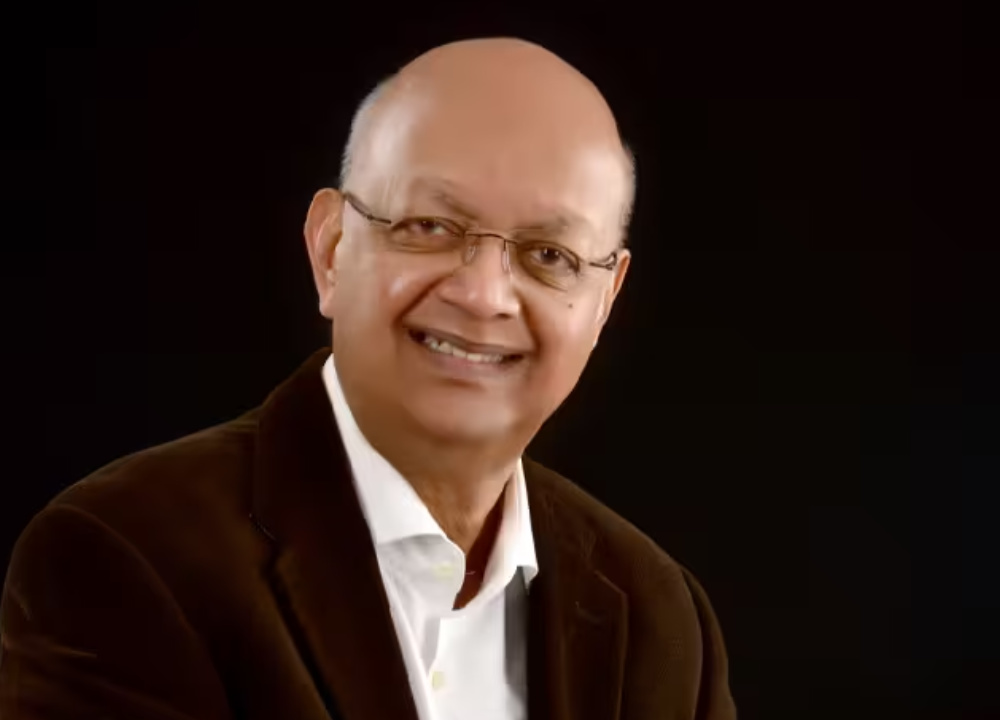
Philip Samuel is the owner of Bangalore-based Indfrag, which he founded in 1989 to extract the essence of natural flowers for use as ingredients in fine perfumery. When it became no longer highly profitable to make flower ingredients, he shifted to plant extracts for Health and Nutrition. The company boomed after that and once again diversified into plant extracts for Cosmetics. Samuel split the company into 2 parts in 2016 and sold the major part at a great valuation, rewarding all shareholders 126 times, compared to the Sensex Index, which multiplied 9.6 times.
Quitting his full-time professional business in 2017, the 70-year-old Samuel still gets enthusiastic when discussing new ideas, innovating, and helping entrepreneurs produce. From collecting used toiletries from star hotels, recycling them, and distributing them to the underprivileged, to championing agriculture, investing in young entrepreneurs in waste management, and taking up tasks for the upliftment of society and its people, the energy and dedication of this 70-year-old are worth following. Samuel is a rare Machine Maker from our country, and his story will surely inspire many; he is a mentor who is not ready to stop until he succeeds.
Having built a successful career as a consultant and entrepreneur, Samuel now wants to give back to society. For a considerable period, Samuel’s passion has been identifying unique venture ideas. He has a multitude of venture ideas in his storage, several of which are relevant in the current world. He wants to offer these ideas free of charge to young people who are looking for venture ideas. For this, he has developed a website, idearampage. His heartfelt desire is to benefit young people by sharing his experience. He aims to spread the message that life’s incidents teach us lessons. In any situation, we always have an alternative. So, if a specific idea fails, it is wrong to lose heart. After reaching the zenith of successful entrepreneurship, Samuel began engaging in various CSR activities. His company is one of the first Indian companies to donate to American charities.
Samuel began his work with a small capital and claims not to be a corporate man with textbook strategies. He runs his company on impulse and instinct, which his managers often find rather strange! But when he sold his company, the shareholders who regularly got a 100% dividend almost every year from 1996 onwards. When the company was sold, they got a 126 times return. Consultants informed Samuel that, compared with a 9.6 appreciation in the Sensex from 1996 to date, he ranks among the top 10 wealth creators.
Samuel was born in 1947 in Tamil Nadu and was the last of his parents’ eight children. His parents named him after Prince Phillip who married Queen Elizabeth in the same year. His father was in Government service in the Revenue Department as a Deputy Collector, who eventually rose to the rank of Director of Industries in Commerce. After completing his preliminary education at a Small Montessori School in Chennai, he attended Madras Christian College High School for his high school education. Thereafter, he enrolled in Vivekananda College. He joined the B.E. (Mechanical) course at College of Engineering, Guindy. He remembers that he was not an exceptional student and that he scored just enough to pass the engineering examination.
His father guided him to serve as an unpaid apprentice in a Government tool room for six months, where he learned through observation. After graduation, he was a Maintenance Engineering trainee in Kunal Engineering, a small-scale textile spindle manufacturer in Ambattur. This company was part of a large group called the Kothari Group, which had a collaboration with a German company. After eight months, in 1970, he was appointed Sales Engineer at Carborundum Universal but was subsequently transferred to projects. This company had a new project in Palghat, Kerala, related to Electrocast Refractories. The company sent him to the US to transfer the technology. At the age of 27, he successfully designed and built the plant in Palghat, which was highly appreciated. He became very interested in continuing work as a Project Manager and set up new manufacturing units. The management at Carborundum appreciated his work and expressed their desire to elevate him to the top rung of the company, for which they wanted him to take a path designed by them and to be posted as a Training Manager in another Group company. Samuel felt that he would not be a good teacher/trainer, and in 1978, he decided to explore his career further.
His next assignment, which was one of the turning points in his career, was with the Tamil Nadu Industrial Development Corporation (TIDCO). The purpose of this public sector company was to promote large-scale manufacturing units in the state. Here, the work was to identify innovative projects, identify and finalize foreign collaborations for technology. The next stage was to obtain all kinds of approvals from the Government of India under the then-prevailing License Raj. At the appropriate stage of the project, the private sector was invited to participate and assume management. Those days, recruiting professionals into TIDCO from the private sector was uncommon, but Samuel’s recruitment was through a dynamic IAS Officer, Shri K P Geetakrishnan, IAS, the then Managing Director of TIDCO, who later became the Union Finance Secretary in Delhi and subsequently joined the World Bank. Samuel had hardcore engineering know-how in setting up a project, including drawing, building, architecture, machinery selection, erection, and commissioning, at Carborundum. In TIDCO, his work was more about promotion, which was concerning facilitative management. The aim was to have joint venture projects. TIDCO wanted to promote and bring the project to a certain stage, but never implemented it or bought land for it. It would invite the private sector to take over the project. The public issue share was of 49%, TIDCO share was of 26%, and the private investor’s share was 25%. TIDCO conceived the idea of Titan for which Samuel was one of the Development Officers. They later sold it to the Tatas. Other TIDCO-promoted units included SPIC, TANFAC, Vanavil Dyes, and Dyna Vision.
Coming out of the regular Government-style of working in 1980, he became a Project Manager at Mettur Beardsell, a famous Textile manufacturer owned by a group in England. While working on some new projects, he came into contact with Murali, a Marketing guy with an MBA. Murali expressed his desire to be on his own and requested Samuel’s assistance in creating a manufacturing venture for which he was ready to provide the finance. Samuel agreed and selected a Precision Optics project. He got collaboration from JML Optics, a small company in Rochester, USA, which was persuaded by Samuel not only to share the technology but also to take a Financial stake with a 40% shareholding. This company is General Optics Asia Ltd., located in Pondicherry. After this first successful venture, Samuel felt that he could become a Consultant and launched a company called Trans Projects Eastern Pvt. Ltd, beginning his entrepreneurship. He began to come up with unique ideas and do all preliminary research such as raw materials, manufacturing processes, technology, and marketing, etc. You need to understand that the research was done when Google or Internet search was not even a dream in people’s minds.
He ensured that his ideas were not commonplace and achieved high profits through foreign collaborations. To sell the project ideas, he used to draft 10 one-sentence project ideas on a sheet of paper and charged prospective clients INR 1 lakh to buy this sheet. The customers were allowed to select 3 ideas. Then, he would charge them INR 25 lakhs for the research of about 10 pages of these 3 ideas. He would provide them with all data on these ideas and introduce them to foreign collaborators. For research, he took painstaking efforts of visiting consulates and reading books, etc. Through these, he could prove the viability and feasibility of a manufacturing project. To cope up with the expenses, it was mandatory that the project cost was minimum INR 3 crores. His clients were big corporates who were looking to diversify, NRIs who were looking to settle back in India, and wealthy youngsters who would like to venture into business. From 1982 to 1987, Samuel was able to execute more than seven projects. One was vacuum coating of Copier drums with American collaboration, Coating HSS cutting tools with Titanium Nitride to increase their life, with a Liechtenstein collaboration. Another one was for Solar flat plate collectors that had double the efficiency of usual Tube and Plate Collectors, which could be used to run Air conditioners in offices, with Australian technology. Another one was color anodizing of Aluminum without using dyes, which was used in the previous Madras airport expansion. Clients were companies like JK Synthetics, Murugappa Group, Sona Steering etc.
In 1987, destiny took Samuel from consulting to manufacturing. One of his attributes was never to tell NO and find ways to execute tasks. A subsidiary of Unilever, a manufacturing unit in South France extracting fresh flowers, was in search of somebody who could make Indian flower extracts. The extraction of fresh flowers was for fine perfumery. The project cost was of INR 45 lakhs. Unfortunately, Samuel had to inform the Unilever representative from Ashford named Andrew Attfield about the unavailability of an entrepreneur to take up this project, due to his low Capital cost. To this, Andrew replied that they trusted Samuel, wanted him to take up the project, and was ready to assist him in all ways possible. In this way, in 1987, Samuel moved on from consultancy to manufacturing. Unilever provided him with free technology with the complete buyback guarantee. The first year was rewarding, but at its end, Unilever sold the unit to Sanofi. Now, the French advised Samuel to sue Unilever. Instead, Samuel, with the support of Andrew, drafted a letter to Unilever to help him out. Accordingly, Unilever gave a good review about Samuel to distributors in the South of France and New Jersey, US. Yet, Indfrag had to struggle to keep afloat, having lost Unilever’s connection.
In 1992, Samuel’s friend informed him about a company called Natural Remedies, which was selling raw herbs to veterinarians and wanted an extract so that the dosage could be small. This proved to be a lucrative business for Samuel, who soon paid off the loans and resolved all financial issues. In 1993, Samuel was given an order by an American company for an extract of Garcinia, which is used for weight management which proved to be a money spinner. He got the raw materials initially from Shimoga (Karnataka) and then from Sri Lanka at a cheaper rate and finally moved to Indonesia. His company was the No. 1 company in the world for the manufacture of garcinia. Today, Garcinia is one of the most popular weight loss ingredients. Having got out of Floral extracts and into Nutrition, the business grew rapidly. Cosmetic ingredients were started in 2006 which also added to the growth of the company. From 2014, the company’s sales jumped from 50 Crores to 100 Crores and then to 150 Crores. This attracted M&A Consultants who helped Samuel to sell part of his company in January 2017. The Cosmetic side was retained and is now managed ably by his son.
Even after taking off from regular business, innovations and ideas inspire him, and he is always there to support people, companies, and industries with his experience, expertise, and resources. He is pained by the way the current generation is looking forward to not taking hardships to attain success. The easy route is in no way helping budding entrepreneurs, people, businesses, or society. He is on a mission to create an equilibrium where people innovate and embrace ideas.